

Welcome, Dear Soul.
Vallalar, born Ramalingam and known as Ramalinga Swamigal or Ramalinga Adigal (1823–1874), was a Tamil saint and poet who taught that compassion for every living being is the way to God. He fed the hungry without regard to caste, wrote about six thousand verses of devotion, and in 1874 entered a room at Mettukuppam and was never seen again.
Vallalar (Vaḷḷalār, “the generous one”) is the name by which Tamil people remember Ramalinga Swamigal (1823–1874), saint, poet and reformer. He founded Samarasa Suddha Sanmarkkam, a path open to all, resting on compassion for every living being (Jeeva Karunyam) and the worship of God as Arut Perum Jothi, the Vast Grace Light.
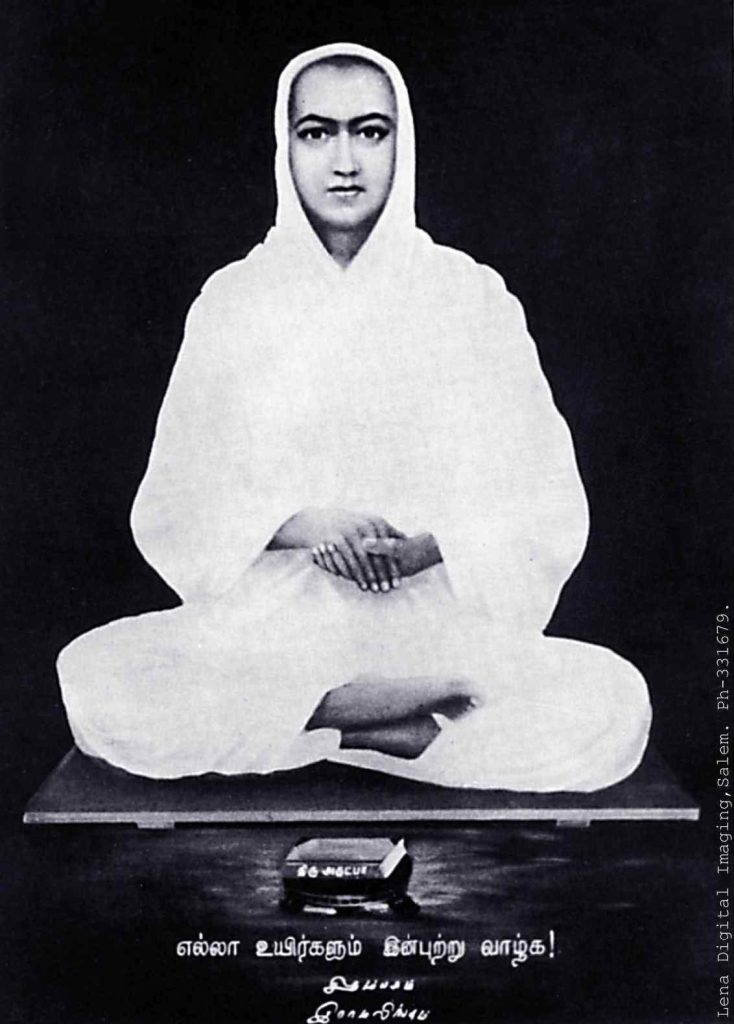
Who was Vallalar?
He was born Ramalingam on 5 October 1823 in Marudur, near Chidambaram in Tamil Nadu, the youngest child of Ramayya Pillai and Chinnammai. His father died when he was an infant, and in 1826 the family moved to Chennai (then Madras), where his elder brother Sabapathi supported them.
Even as a boy, Ramalingam preferred prayer to the lessons his brother arranged. He spent long hours alone in a room with a lamp and a mirror, and began composing devotional songs to Murugan at the Kandasamy temple in Chennai while still a child. Scholars of the city were astonished that one so young, without formal schooling, wrote Tamil of such depth.

He is also called Thiru Arutprakasa Vallalar, “the generous one who reveals the light of grace”. Over the years his worship moved from God in many forms to God as formless light, present in every being. That shift shaped everything he later taught.
Why is Vallalar called the saint-scientist?
Because he treated the spiritual life as something to be tested, not only believed. He trusted direct experience over custom and scripture, set aside rituals he found empty, and made his own life the place where his teaching was proved: in the free kitchen, in his daily discipline, and in the change he described in his own body. He wrote down what he experienced so that others could follow and test it for themselves. For the people who call him the saint-scientist, his path is a practice whose results anyone can see.
What did Vallalar teach?
His path, Samarasa Suddha Sanmarkkam (“the pure true path of universal harmony”), rests on three teachings.
Compassion for every living being (Jeeva Karunyam). For Vallalar this was not one virtue among many. It was the path itself. In Compassionate Conduct to Life (Jeeva Karunya Ozhukkam) he explains why: “Grace is God’s compassion; it is the manifestation of God’s nature. Soul-compassion is the compassion of souls; it is the manifestation of the soul’s natural state. Therefore, one can attain compassion through compassion.” (¶ 1.06) Relieving hunger came first, and refusing to kill came with it, which is why his path is plant-based.
One God, the Vast Grace Light (Arut Perum Jothi). In The True Petitions (Vinnappangal), his four petitions to God, he records what grace made him know: “There is one true God, who shines everywhere as the Complete One.” (The True Petitions, § 13) He called on that God as Arut Perum Jothi and gave a short invocation, the Mahamantra: Arut Perum Jothi, Arut Perum Jothi, Thani Perum Karunai, Arut Perum Jothi.
The oneness of all souls (Anma Neya Orumaipadu). Every soul is kin to every other. Vallalar saw caste, and the divisions between religions and sects, as the chief obstacle to this. In the same book he prays that “the worldly customs, notions and distinctions such as caste and the stages of life, never take hold of our minds” (The True Petitions, § 18). He welcomed everyone, of any faith or none, and asked no one to leave their own.
Why does Jeeva Karunyam matter today?
A century and a half later, the cost of ignoring other living beings is plain to see. Agricultural expansion causes almost 90 per cent of the world’s deforestation, and grazing land for livestock is close to 40 per cent of it (FAO, 2021). Around three in four new infectious diseases in people come from animals (UNEP, 2020), and some, like “mad cow” disease, were born directly from the way we farm and feed animals. Vallalar did not have these numbers. He had the principle behind them: harm done to one living being does not stay with that being.
What is the “deathless life”?
Vallalar taught that death is not God’s final will for the human being. Through compassion and grace, the body itself can be changed: first made pure and free of disease (Suddha Deham), then subtle and full of grace (Pranava Deham), and at last one with the Grace Light (Gnana Deham). The True Petitions put the hope plainly: “By the illumination of that grace we can be freed from death, disease, old age, fear, suffering and all such afflictions.” (§ 13)
A challenge often attributed to him puts it in a few words: “Do you accept death? If not, do something about it. Follow my example.” He did not keep this hope for himself. In the last of The True Petitions he asks God that every living being who has received a human body be made “a holder of that right” and live that life (§ 7).
For many who follow him, this is the heart of his message, and the reason his disappearance is taken literally. Our page on the point of life explains the three stages more fully, and how to overcome the fear of death shows what the teaching offers someone who is afraid.
What did he build at Vadalur?
In 1858 Vallalar left Chennai for the south. He lived for some years at Karunguzhi and then settled in and around Vadalur, in today’s Cuddalore district. There his teaching took the form of three lasting institutions, and two of them can still be visited: our guide to Vadalur describes them as they are today.
- The Sangam (1865). He gathered his followers in a fellowship first called the Samarasa Vedha Sanmarga Sangam and renamed in 1872 the Samarasa Suddha Sanmarga Sathya Sangam.
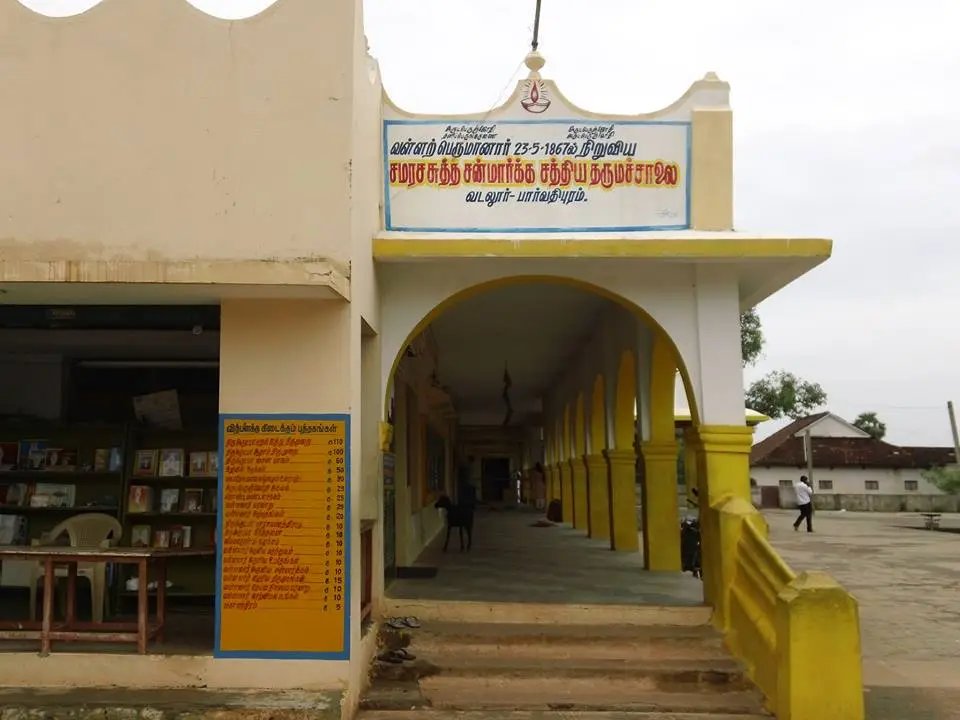
- Sathya Dharma Salai, the free kitchen (1867). Vallalar lit its stove and opened its doors to anyone who was hungry, without distinction of caste, creed or nation. It has fed people every day since; devotees say the fire he lit has never gone out.
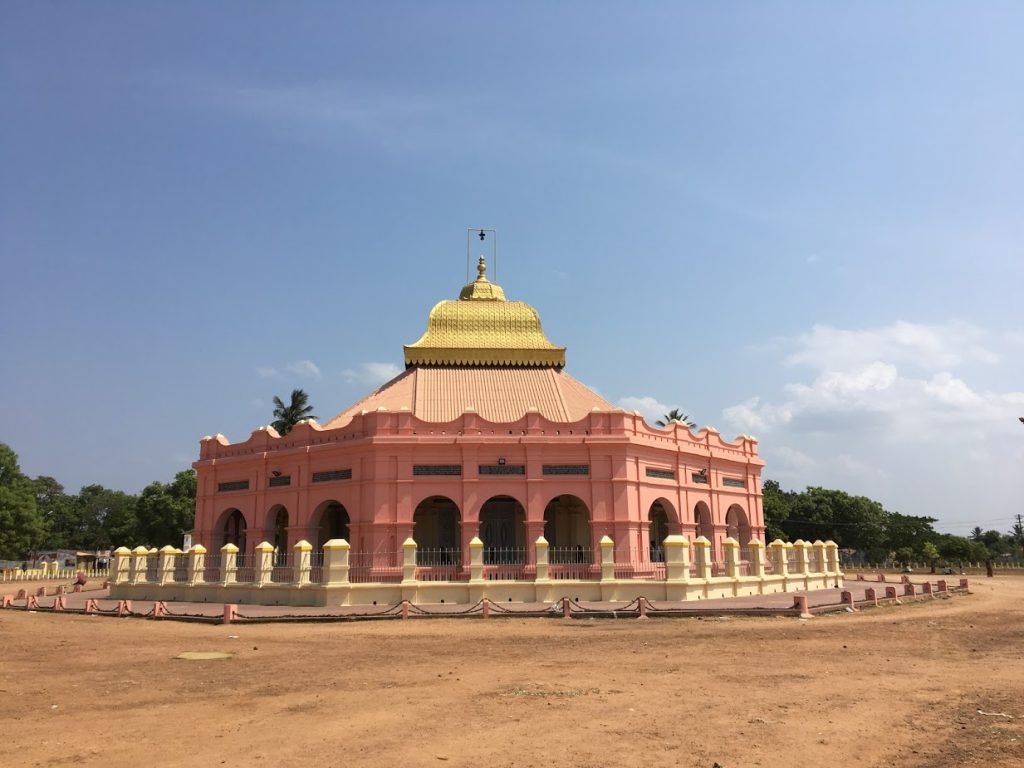
- Sathya Gnana Sabai, the Hall of True Wisdom (opened 25 January 1872). An eight-sided hall with no idol inside, only a lamp seen through seven coloured screens that stand for the veils over the soul. On the festival of Thaipusam the screens are drawn back and pilgrims see the light, the Jothi Darshan. By his instruction, only those who have given up killing and eating meat may enter the inner hall.
How did Vallalar disappear?
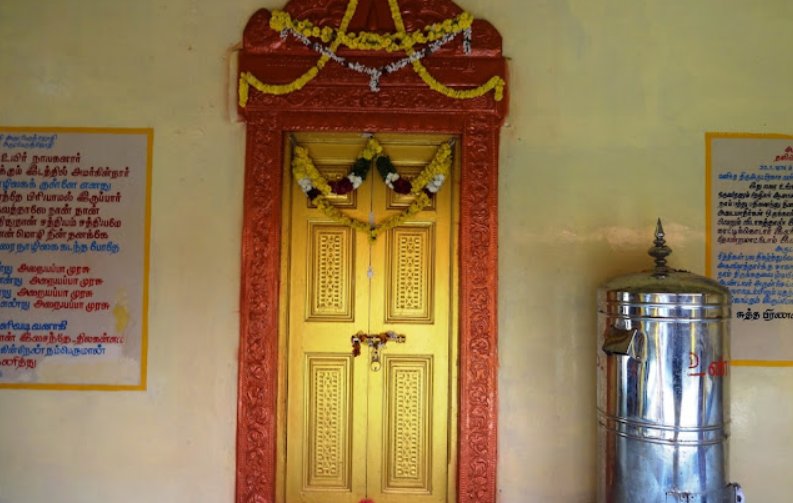
In his last years Vallalar lived at Siddhi Valagam in Mettukuppam, near Vadalur, where in October 1873 he gave his final great discourse, The Great Teaching (Perupadesam). On 30 January 1874 he entered his room there, asked that the door be locked from outside, and told his followers not to look for him. He was never seen again, and no body was ever found.
When the room was later opened, it was empty. His disappearance was recorded in the South Arcot volume of the Madras District Gazetteers, published in 1906, and a stone at Vadalur reproduces that note.
Is there a photograph of Vallalar?
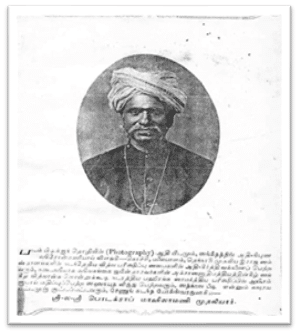
No photograph of Vallalar is known to exist. Devotees tell that a photographer, Masilamani Mudaliar, tried several times to take his picture and that only his white cloth appeared on the plates. Another account says he cast no shadow in sunlight. The portraits we know today, of a slender figure in plain white cloth with his head covered, are paintings based on the descriptions of those who knew him.
What did Vallalar write?
His writings fill thousands of pages, in verse and in prose. Our translations give the Tamil text beside each one, free to read and download.
Songs of Divine Grace, the Thiru Arutpa. About six thousand verses in six books (Thirumurai), from the devotional songs of his youth to the songs of the Grace Light in the sixth. The best known is the Arutperunjothi Agaval, a single hymn of 1,596 lines. The Agaval and Songs of Grace, Book II, Book III and Book IV are published as review drafts; Books I, V and VI are in preparation. All of them gather on the Thiru Arutpa page.
The prose works, the Urainaidai. Here Vallalar explains the path in plain words (all prose works):
- The True Petitions (Vinnappangal): all four of his petitions to God in one book, quoted above.
- The Major Philosophical Commentaries (Vyakhyanangal).
- Compassionate Conduct to Life (Jeeva Karunya Ozhukkam): his foundational teaching on compassion toward all living beings. If you read one work, read this.
- The Great Teaching (Perupadesam): his final great discourse.
- Rules of Daily Conduct (Nithya Karma Vidhi): guidance for each day, for food, rest and inner life.
- The Justice of King Manu (Manu Murai Kanda Vasagam): the king who gave justice to a calf.
- Notes on the Teachings (Upadesa Kurippukal).
The True Petitions and the Major Philosophical Commentaries are final editions (Edition 1.0), archived with permanent DOIs on Zenodo and at the Internet Archive. Everything is listed on our books page.
Our own books, coming soon: How to Live a Happy, Healthy, Compassionate, Immortal Life, a modern guide rooted in Vallalar’s wisdom, and the Sanmarkkam Recipe Book, plant-based cooking in the spirit of Jeeva Karunyam.
Did Vallalar write about medicine?
Yes. Vallalar cared for the body as the dwelling of the soul, and his followers preserved his notes on herbs and remedies in the Siddha tradition: The Table of Herbal Properties (Mooligai Guna Attavanai), a chart of 485 medicinal plants, and his Medical Notes (Maruthuva Kurippugal). In his system, the body is kept pure and strong so that it can receive grace, and certain herbs serve that purpose:
- Karisalankanni (Eclipta prostrata), which he called the herb of wisdom, is considered in this tradition to clear phlegm, balance the blood, help with jaundice and sharpen memory. His notes advise steaming it in milk rather than water.
- Thoothuvalai (Solanum trilobatum) is traditionally used for the throat and for congestion in the lungs.
- Musumusukkai (Mukia maderaspatana) is traditionally used to calm the breathing.
Siddha practice also holds that such herbs help the blood carry more oxygen and cool excess heat (pitham) in the body, and that reciting the Arutperunjothi Agaval in Tamil calms and clears the mind.
These are the views of a traditional system of medicine, not medical advice: please ask a doctor before using any herb, especially if you are ill or take medicines. Our Emporium prepares herbs from this tradition on a donation basis.
Questions people ask
What does “Vallalar” mean?
“The generous one” in Tamil. It is the name people gave Ramalinga Swamigal for his open-handed compassion, above all his free kitchen.
When and where was Vallalar born?
On 5 October 1823 in Marudur, near Chidambaram, Tamil Nadu.
What happened to Vallalar?
On 30 January 1874 he entered a room at Mettukuppam near Vadalur, which was locked from outside. He was never seen again and no body was found.
What is Vallalar’s main teaching?
Compassion for every living being (Jeeva Karunyam) as the way to God’s grace, worship of one God as the Vast Grace Light, and the oneness of all souls beyond caste and religion.
What is the Vallalar mantra?
Arut Perum Jothi, Arut Perum Jothi, Thani Perum Karunai, Arut Perum Jothi: “The Vast Grace Light, the Vast Grace Light, the Unique Great Compassion, the Vast Grace Light.”
Where can I read Vallalar’s books in English?
His prose works are free to read on our site in translation, with the Tamil text; start with Compassionate Conduct to Life. The Songs of Grace are being published book by book.
Can I visit Vadalur?
Yes. The free kitchen and the Hall of True Wisdom are open to all. Thaipusam, in January or February, draws the largest gathering for the Jothi Darshan.
Further reading: Ramalinga Swamigal on Wikipedia.
If you’d like to come to know Vallalar slowly, through his own words, the Sanmarkkam Journey brings them to you one email at a time. The Sanmarkkam Journey delivers free teachings, health guidance and translations of Vallalar’s works directly to your inbox, at your own pace. No pressure, no selling. Unsubscribe with one click. Join the Sanmarkkam Journey

Want Vallalar's wisdom
delivered free to your inbox?
All directly to your favourite email inbox.
We take you by hand, at your own pace. Step-by-Step.
- Free E-book: Jeevakarunyam Ozhukkam — Vallalar's Guide to Compassionate Living IMMEDIATE DOWNLOAD
- Free E-books, translations & commentaries
- Free health tips from Vallalar's manuscripts
- Free community
- Free Emporium items
- & Much More 🎁
🕯️ Welcome to the Journey
Look for an email from international@sanmarkkamlife.org. Check your inbox, spam folder and Promotions tab. Your first teaching and your free e-book are on their way.
🔒 We hate Spam. No Pressure. 0 Selling or Pitching.
1 Click Unsubscribe any time.
Privacy Policy · Sanmarkkam Life APS · GDPR compliant